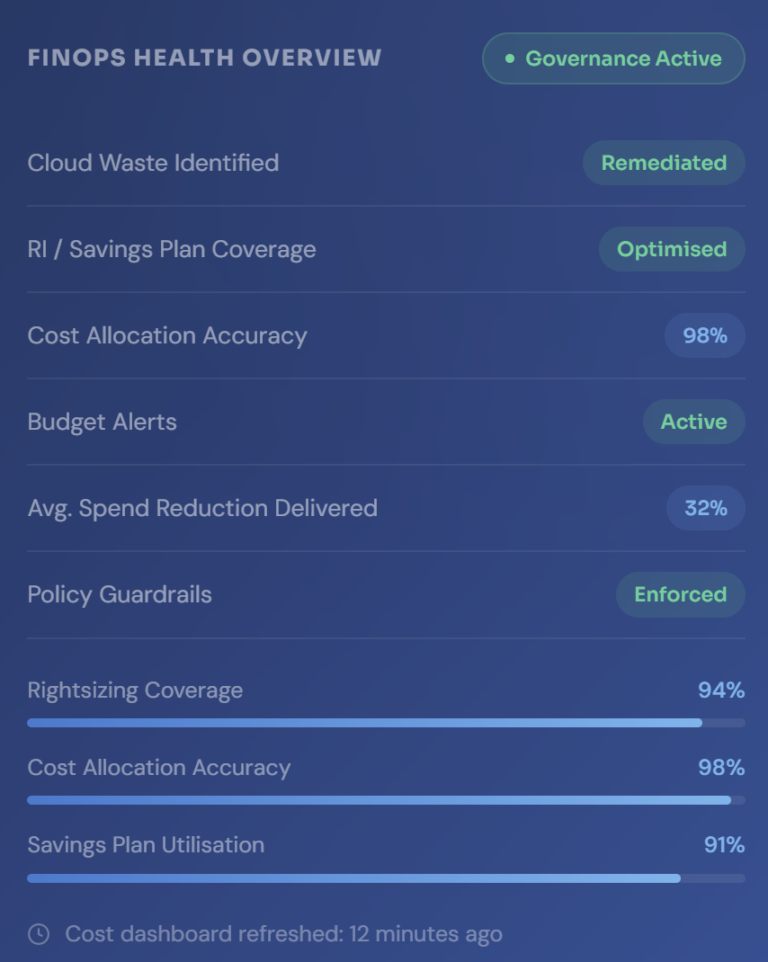
Cloud spend is your second or third largest technology cost — and most organisations are wasting 25–35% of it. Gigamatics brings a structured FinOps practice to give your business full visibility, enforceable governance, and a clear path to measurable, sustained cost reduction — without sacrificing performance or velocity.
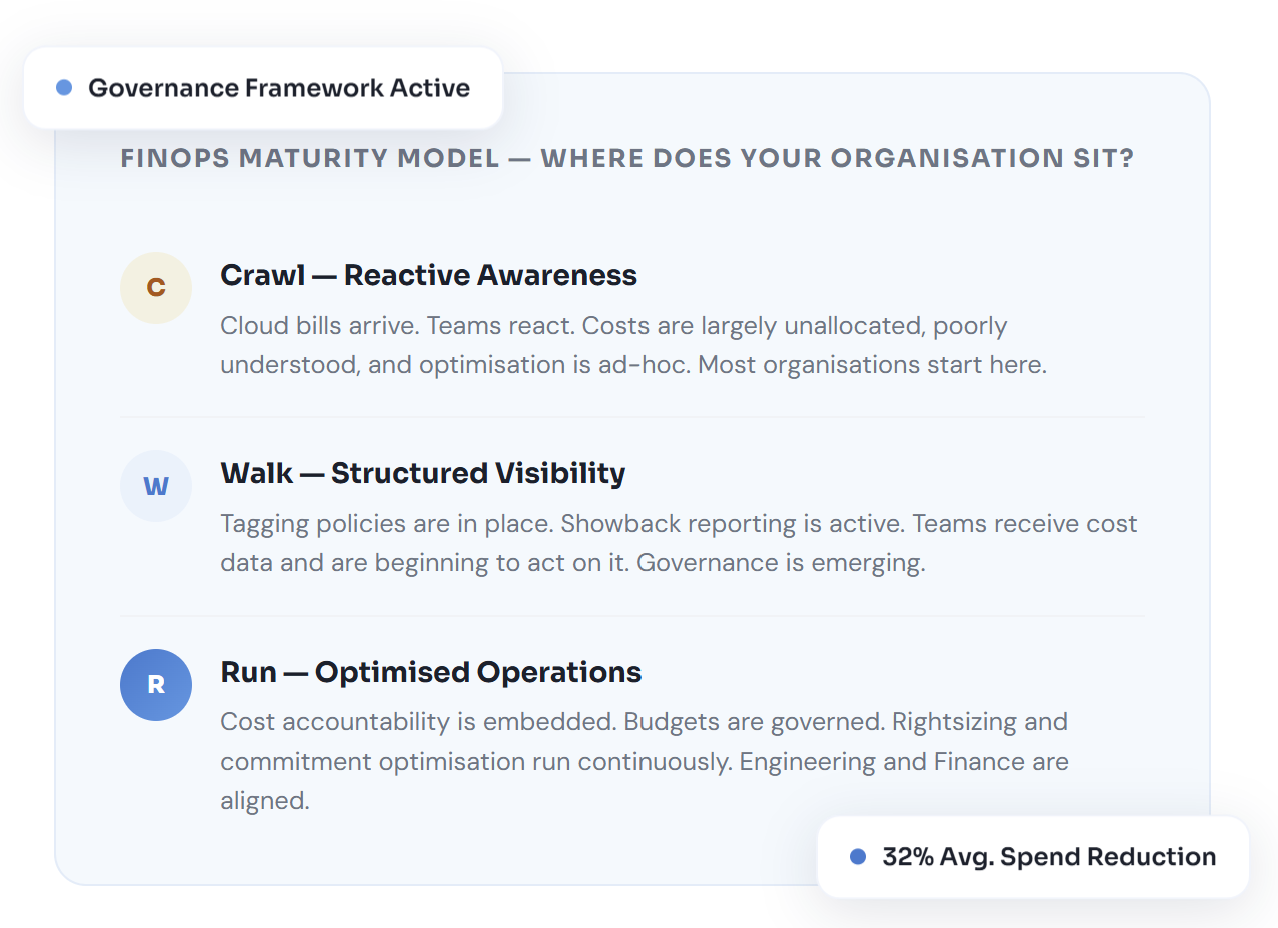
FinOps is not a cost-cutting exercise. It is a financial operating model for cloud — bringing together engineering, finance, and operations to make deliberate, informed decisions about cloud spend at scale.
Organisations that treat cloud cost as a byproduct rather than a managed variable consistently overspend — often by 25–35%. Gigamatics implements FinOps as a structured practice: visibility frameworks, governance controls, accountability models, and optimisation engines running continuously.
A structured, end-to-end FinOps practice built to deliver visibility, governance,
and sustained optimisation across your cloud estate — not a one-time cost review.
Establish a complete, accurate view of cloud spend — mapped to the teams, products, and workloads that generate it. Remove ambiguity from your cloud bill entirely.
Systematically identify over-provisioned, underutilised, and misconfigured resources — and right-size them to match actual workload demand without degrading performance.
Design and implement the right mix of Reserved Instances, Savings Plans, and spot usage — structured to maximise commitment discounts without over-committing to workloads that change.
Identify and eliminate idle, orphaned, and zombie cloud resources — the silent cost drains that accumulate across environments over time and rarely appear on any dashboard.
Design and implement the policies, budgets, guardrails, and accountability structures that ensure cost optimisation is a continuous discipline — not a periodic exercise.
A structured evaluation of your current FinOps maturity — covering visibility, accountability, tooling, governance, and optimisation practice — with a prioritised roadmap to the next level.
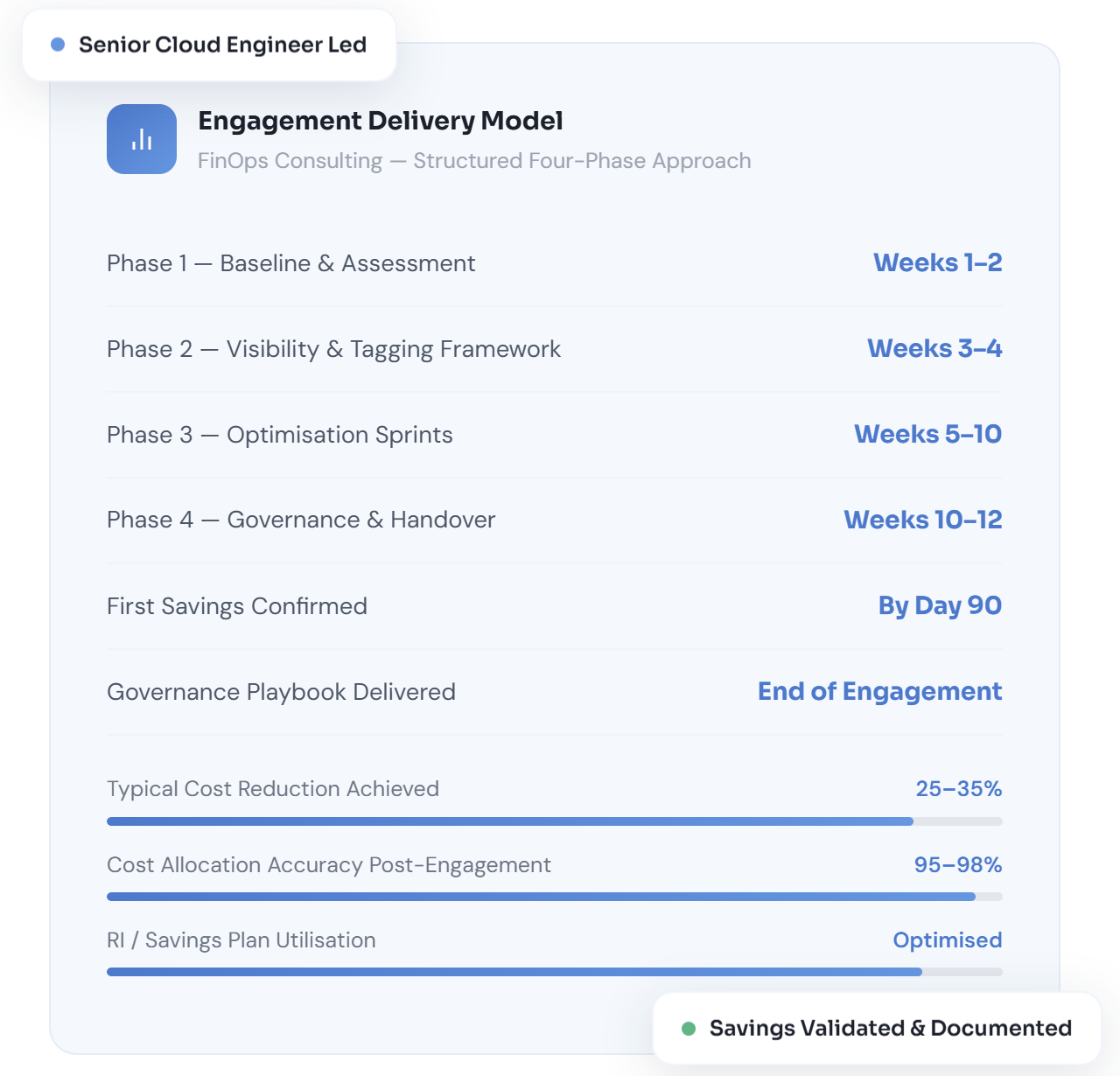
Every Gigamatics FinOps engagement follows a defined four-phase delivery model — moving from baseline visibility through to self-sustaining cost governance that works without ongoing external intervention.
Full analysis of your cloud estate — spend by service, team, region, and workload. Tagging gaps, idle resources, and commitment utilisation documented with savings opportunity estimates by category.
We design and implement the tagging strategy, cost allocation model, and dashboards that give engineering and finance complete, real-time visibility into cloud spend and accountability by team.
Structured sprints targeting rightsizing, waste elimination, and commitment purchasing — each with defined targets, risk-qualified changes, and post-implementation savings validation before the next sprint begins.
Policies, budgets, guardrails, and review cadences embedded into your team's workflow — ensuring cost discipline continues as workloads scale, without requiring constant external support.
Every optimisation action is confirmed with before-and-after evidence. You receive a structured savings report at engagement close — not a list of recommendations with no proof of impact.
We work with native cloud cost management tools and leading third-party FinOps platforms — selecting
the right tooling for your estate size, multi-cloud complexity, and team capability.
AWS Cost Explorer, AWS Budgets, AWS Trusted Advisor, Azure Cost Management, Azure Advisor, Google Cloud Billing, and GCP Recommender — configured and governed as part of every engagement.
CloudHealth by VMware, Spot.io (NetApp), Apptio Cloudability, and Kubecost for Kubernetes cost management — evaluated and deployed where they add clear measurable value over native tooling.
Where native tooling gaps exist, we build custom cost dashboards using Grafana, Power BI, or Looker — giving engineering and finance leadership the right view at the right granularity.
Every FinOps engagement activity runs on a defined schedule. Every
deliverable is documented, tracked, and reviewed with your team at each phase gate.
|
Deliverable / Activity
|
Description
|
Phase
|
|---|---|---|
|
Cloud Cost Baseline Report
|
Full estate spend analysis mapped by service, team, and region. Tagging gaps, idle resources, and savings opportunity estimates documented and formally presented.
|
Phase 1
|
|
Savings Opportunity Register
|
Prioritised list of savings opportunities across rightsizing, waste, commitment, and architectural categories — with estimated value and implementation risk rating per item.
|
Phase 1
|
|
Tagging Strategy & Policy
|
Designed tagging taxonomy, enforcement policy, and rollout plan covering all accounts, services, and environments across your cloud estate.
|
Phase 2
|
|
Cost Allocation Framework
|
Allocation model mapping cloud spend to business units, products, and teams — including showback or chargeback design based on your operating model requirements.
|
Phase 2
|
|
Cost Dashboards & Alerting
|
Live dashboards providing real-time spend visibility by team and workload — with anomaly detection and budget breach alerts configured and tested before Phase 3 begins
|
Phase 2
|
|
Rightsizing Sprint
|
Risk-classified rightsizing changes implemented in a governed sprint — with pre- and post-performance validation and confirmed savings documented per action taken.
|
Phase 3
|
|
Waste Remediation Sprint
|
Idle VMs, orphaned volumes, unused IPs, and dev/test environment waste eliminated — with approval workflow, rollback capability, and documented cost impact per item.
|
Phase 3
|
|
Commitment Optimisation
|
Reserved Instance and Savings Plan portfolio designed and purchased — with utilisation targets set and monitoring configured to track ongoing efficiency post-purchase.
|
Phase 3
|
|
FinOps Governance Playbook
|
Documented governance framework covering budgets, policies, guardrails, review cadences, and RACI — ready for your team to operate independently after engagement close.
|
Phase 4
|
|
Validated Savings Report
|
Final engagement report confirming cost reductions achieved — with before/after evidence per category, total savings realised, and recommendations for sustaining them long-term
|
Phase 4
|
|
Monthly Cost Review (Retainer)
|
For ongoing retainer clients — monthly cost trend review, optimisation opportunity update, and governance compliance check delivered as a structured monthly report.
|
Ongoing
|
Most cloud cost reviews are done by generalist consultants with spreadsheets.
Gigamatics brings senior cloud engineers to the FinOps problem — people who
understand workloads, architecture, and the real trade-offs involved in every
optimisation decision.
Cost optimisation decisions involve real trade-offs between performance, reliability, and developer velocity. Our FinOps practice is led by cloud architects who understand workload behaviour — not just unit pricing.
We don’t produce opportunity lists and leave implementation to you. Every recommendation is validated, risk-classified, and implemented — with before-and-after savings confirmed and documented in writing.
We build the frameworks, policies, and accountability structures that sustain cost discipline after we leave — so your organisation manages cloud spend well independently, without continuous external support.
FinOps does not exist in isolation. Cost optimisation decisions affect architecture, security posture, and platform strategy. Our cloud practice integrates FinOps with your complete technology operating model.
Consistent, validated outcomes delivered across cloud estates of varying size, maturity, and complexity.
Across rightsizing, waste elimination, commitment optimisation, and architectural efficiency — sustained reductions achieved within 90 days of engagement start, not one-time gains that erode over time.
After tagging strategy and allocation framework implementation, organisations achieve near-complete visibility into which team, product, or workload is generating every line of cloud spend.
The structured sprint model delivers confirmed, measurable savings within 90 days of engagement kick-off — not after a six-month consulting project with no tangible cost impact.
Organisations with poorly utilised Reserved Instances or Savings Plans consistently achieve three times greater commitment efficiency post-engagement — eliminating wasted reservation spend outright.
With properly configured budgets, anomaly alerts, and policy guardrails in place, clients eliminate the unplanned cost spikes that previously generated month-end surprises on the cloud invoice.
The FinOps operating model, showback reporting, and governance cadences embed cost accountability into engineering culture — ending the disconnect between teams that spend and teams that pay.
2–3 week structured analysis — documented baseline, waste inventory, and savings opportunity register with estimates by category.
Written report quantifying savings potential across rightsizing, commitment, waste, and architectural categories — with a prioritised action roadmap.
Your conversation is with the practitioner who will run the engagement — not a sales lead. Every discussion is technically grounded and immediately useful.
Have a specific question about your cloud estate, tooling, or savings potential? Our practitioners are ready to talk.
No. Organisations spending $10K/month on cloud can benefit significantly — particularly around tagging, commitment strategy, and waste elimination. The ROI is often highest at mid-market scale where governance structures haven’t yet been built.
Most clients see confirmed savings within 30–60 days of the optimisation sprint phase beginning — typically starting with waste elimination and rightsizing, which deliver the fastest confirmed gains. Commitment optimisation savings materialise as Reserved Instances or Savings Plans are purchased. Total validated savings are achievable within 90 days of engagement kick-off for most cloud estates.
Every recommendation is risk-classified before implementation. Rightsizing actions are validated against historical performance data and workload behaviour before any changes are made. High-risk changes are tested in non-production environments first. We do not implement changes that compromise performance or reliability — if a genuine trade-off exists, we present it transparently and let you decide.
Internal cloud teams are typically focused on delivery and platform operations — not cost governance. FinOps consulting adds structured methodology, tooling expertise, and an external perspective that internal teams rarely have the capacity to build. We work alongside your existing team to implement the frameworks they need, then transfer capability so they can sustain them independently after engagement close.
No. The assessment phase works with your existing native cloud billing data — AWS Cost Explorer, Azure Cost Management, or Google Cloud Billing — which is available to every cloud customer at no additional cost. We evaluate whether third-party tooling is warranted based on your estate size and complexity, and recommend specific platforms only where the savings clearly justify the investment.
A cloud cost review produces a list of recommendations. FinOps is an operating model — it implements visibility, governance, accountability, and continuous optimisation as ongoing practices embedded in your organisation. The difference is between a one-time dietary advice session and building a sustainable nutrition framework. We implement the latter — and leave the capability with your team.
Yes. We manage FinOps across AWS, Azure, and GCP simultaneously — normalising spend data across clouds into a unified allocation framework and consolidated dashboard view. Multi-cloud environments often have the greatest optimisation potential due to inconsistent governance across providers, and we have native engineering expertise across all three major platforms.
Connect with our team to discuss your data, cloud, or security landscape and define a clear, structured path forward.
Testimonials
Pricing
Single Project
Single Prost
Portfolio