We help enterprises design, migrate, and govern cloud and infrastructure platforms with clarity, architectural rigour, and defined ownership — from assessment through stable production operations.
Architecture, roadmap, cloud model selection
Secure foundations, account structure, guardrails
Phased waves, dependency mapping, cut-over
VPC, segmentation, IAM, policy enforcement
Allocation, optimisation, spend control
Modern cloud challenges extend far beyond infrastructure provisioning. Organizations today face legacy on-prem environments, fragmented architectures, rising cloud costs, inconsistent governance, security exposure, and platforms that struggle to scale with business growth.
We help enterprises modernize infrastructure, migrate workloads to the cloud, optimize performance, and establish disciplined operating models with accountability from assessment through stable operations. Cloud transformation is not a tooling initiative; it is the design and operation of secure, scalable, and cost-efficient platforms.
Enterprise cloud strategy aligned to architecture, risk tolerance, regulatory constraints, and target operating models.
Assessment of infrastructure, application dependencies, and regulatory requirements to define the right public, private, or hybrid cloud model.
Includes target architecture and a phased adoption roadmap.
Governance for predictable and controlled cloud spend.
Implementation of cost allocation, usage visibility, and optimization controls.
Enables accountability and informed cost-performance decisions.
Structured migration of applications and infrastructure.
Planned execution of application, data, and infrastructure migrations using phased waves and dependency mapping.
Focused on controlled cutovers, risk mitigation, and post-migration validation.
Secure, scalable enterprise connectivity design.
Design of network and connectivity patterns across on-premises and cloud environments.
Focused on performance, resilience, and secure access.
Integrated operations across on-premises and cloud platforms.
Design of hybrid architectures and operating models covering security, monitoring, and change management.
Ensures consistent governance and clear ownership across environments.
Operational ownership for production cloud platforms.
Ongoing monitoring, incident management, and performance optimization.
Delivered with defined accountability and continuous improvement.
We take end-to-end ownership of cloud transformation initiatives — from strategy and architecture through migration and steady-state operations. Our objective is not simply to move workloads, but to establish resilient, governed, and scalable cloud platforms built for long-term performance.
Every engagement is defined by clear scope, structured accountability, and measurable outcomes, ensuring modernization efforts deliver tangible improvements in reliability, efficiency, and cost predictability.
Evaluating existing infrastructure, workloads, network architecture, security posture, and cloud readiness to define a clear, risk-aware modernization strategy aligned to enterprise priorities.
Modernizing infrastructure foundations, establishing secure cloud landing zones, and executing structured workload migrations to scalable, production-ready cloud environments.
Designing resilient cloud architectures, identity and access models, connectivity frameworks, and governance controls to support secure, efficient day-to-day operations.
Optimizing cloud workloads, controlling spend through governance and FinOps practices, and engineering high-availability environments built for long-term stability.
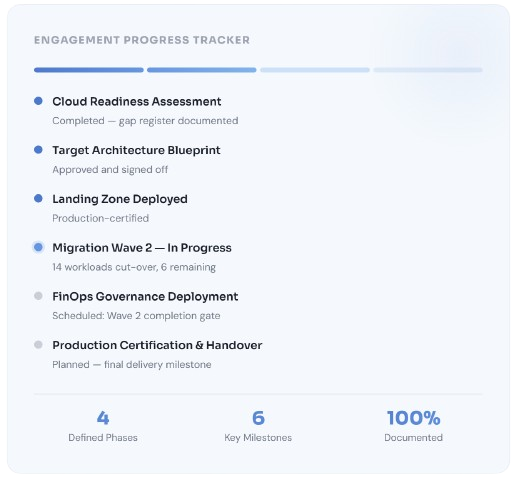
Cloud environments must support high-availability workloads, controlled cost structures, secure access models, and scalable network architectures. We design platforms with these operational constraints at the centre of every decision — not bolted on after architecture is locked.
Capacity requirements, cost implications, and operational risks are evaluated during the architecture phase — before infrastructure is provisioned. We design platforms that anticipate operational realities rather than discovering them after go-live. Reactive cloud operations are not a fact of life; they are the consequence of architecture decisions that didn't account for production conditions.
Architectures are designed for resilience, high availability, and recovery — validated against real production traffic patterns, failure scenarios, and growth projections. We do not optimise for demonstration environments or proof-of-concept simplicity. Every design decision is tested against the question: will this hold under actual enterprise conditions?
Identity, access controls, network segmentation, compliance alignment, and policy enforcement are embedded at the platform foundation — not added as security reviews after architecture is finalised. A security control added after design is a compensating control. A security control built into the foundation is an architectural guarantee.
Every component of the cloud environment has a defined owner, a documented operating model, and a clear handover process. Ambiguity in cloud ownership is one of the leading causes of operational incidents, security gaps, and uncontrolled cost growth. We define ownership explicitly — in writing, from the strategy phase through to steady-state operations.
Structured service areas — each with a defined scope, clear deliverables, and a senior engineer
accountable for outcome from kickoff to production certification.
A structured evaluation of your current environment — producing a documented cloud readiness score, dependency map, risk register, and prioritised modernisation roadmap with estimated effort and sequencing logic.
Design and deployment of a production-ready cloud landing zone — multi-account structures, identity federation, VPC topology, governance guardrails, and centralised logging configured before any workload migrations begin.
Phased migration execution — wave planning, dependency sequencing, cutover orchestration, and post-migration performance validation before each wave is declared stable and the next begins.
End-to-end network and security architecture — from VPC design and traffic inspection to hybrid connectivity, private endpoints, and enforcement of least-privilege access across cloud and on-premises environments.
Cloud transformation does not end at migration. Production environments require structured operations,performance oversight,
cost governance, and continuous improvement. Our managed services practice continues where implementation ends.
Operational control across compute, storage, and network layers — managing infrastructure foundations that support enterprise workloads with defined SLAs and monthly reporting.
SRE-led managed operations — SLO tracking, error budget management, capacity planning, incident coordination, and observability engineering for cloud-native platforms.
Continuous security posture monitoring, vulnerability management, access control governance, and compliance reporting across SOC 2, ISO 27001, HIPAA, PCI-DSS, and GDPR.
Structured FinOps consulting — cloud cost visibility, rightsizing, waste elimination, commitment strategy, and governance frameworks that sustain savings as workloads scale.
Cloud transformation requires disciplined execution and clearly defined ownership.
Our engagements are structured around tangible deliverables and documented standards — not effort and intentions.
Concrete technical and operational outputs delivered throughout the cloud engagement lifecycle — documented, reviewed, and accepted at each phase gate.
Structured delivery governance with measurable milestones, defined accountability, and operational standards applied across every cloud engagement.
Clearly defined scope and ownership model from kickoff — no ambiguity about who is responsible for what.
Structured phases with documented outputs, gate reviews, and reporting cadence — each phase accepted before the next begins.
Change and release management discipline across all infrastructure modifications — with rollback capability maintained throughout.
Formal risk identification and mitigation controls documented and reviewed at every phase gate — not managed informally.
Operational oversight period following migration completion — validating stability before formal handover.
Documented continuous improvement roadmap delivered at engagement close — with prioritised actions for the operations team.
Specific questions about your cloud environment, migration planning, or engagement scope? Our cloud architects are ready to talk.
Consulting engagements design and implement. Managed services operate what's been built. Most organisations benefit from a consulting engagement first, transitioning into managed operations once the platform is stable. We advise on the right structure for your organisation during the initial conversation.
Duration depends on estate complexity, number of workloads, and regulatory constraints. A focused assessment typically takes two to three weeks. Landing zone deployment adds three to six weeks. Migration execution is wave-based — with each wave taking four to eight weeks depending on workload complexity and your team’s change management process. We define a realistic timeline with documented milestones at the assessment stage, before any architecture or migration work begins.
Yes. We design and implement multi-cloud architectures across AWS, Azure, Oracle and GCP — including unified identity federation, cross-cloud networking, consistent governance frameworks, and observability across all three platforms. Multi-cloud environments often introduce governance complexity that single-cloud environments don’t face, and we explicitly account for this in operating model design and tooling selection.
Strategy determines what to build and why — cloud model selection, migration prioritisation, operating model design, and governance frameworks. Architecture determines how to build it — specific technology choices, network topology, identity design, and implementation blueprints. For most organisations, strategy precedes architecture, though they often overlap. We can engage at either level, or both, depending on where your organisation’s current thinking stands.
Yes — hybrid cloud is a core part of our practice. Not every workload should move to public cloud, and hybrid operating models require specific architectural thinking around workload placement, network connectivity (Direct Connect, ExpressRoute, VPN), identity bridging, and consistent governance across both environments. We design hybrid architectures that function as genuinely integrated operating models — not two separate environments managed independently.
Regulatory requirements — GDPR, PCI-DSS, HIPAA, ISO 27001, SOC 2, and sector-specific obligations — are captured in the assessment phase and explicitly mapped to architecture and governance decisions. Data residency, encryption standards, access control requirements, and audit logging obligations are designed into the platform foundation — not treated as compliance overlays applied after architecture is finalised.
Yes. All infrastructure deployments are implemented as code — Terraform or OpenTofu as standard, with CloudFormation, Bicep, or Pulumi for platform-specific requirements. Infrastructure-as-code ensures repeatability, auditability, and the ability to version-control your cloud environment. Every configuration delivered to your team is documented, version-controlled, and deployable by your own engineers without dependence on Gigamatics tooling or access.
Knowledge transfer is a formal deliverable, not an afterthought. Architecture documentation, operational runbooks, IaC repositories, and configuration baselines are delivered to your team in a structured format. We include a post-engagement stabilisation period and a handover session with your operations team. Where ongoing managed operations are required, we transition to a defined managed service engagement with clear operational scope rather than leaving your team to manage an unfamiliar environment independently.
Connect with our team to discuss your data, cloud, or security landscape and define a clear, structured path forward.
Testimonials
Pricing
Single Project
Single Prost
Portfolio