We design, validate, and operationalise enterprise disaster recovery and business continuity programmes — engineering measurable RTO/RPO outcomes, proven failover capability, and organisational readiness for the moments that matter most.
Failover topology, replication, recovery zones
Measurable targets, gap analysis, remediation
BIA, BCP documentation, continuity frameworks
Tabletop exercises, live failover tests, war games
Runbooks, escalation paths, comms protocols
Resilience is not a single tool or backup job — it is an engineered capability.
Our disaster recovery and business continuity services cover architecture, automation, testing, and operational readiness across cloud, hybrid, and on-prem environments.
We focus on aligning recovery design with real business impact — identifying critical systems, defining acceptable downtime, and engineering recovery paths that work under pressure. This ensures recovery strategies are not theoretical documents, but executable plans that restore operations within defined RTO and RPO thresholds.
Each capability below is designed to work independently — and together as a complete recovery system.
Designing recovery architectures that meet defined RTO/RPO targets — warm standby, pilot light, active-active, and multi-region failover configurations across cloud and hybrid environments.
Most organisations have RTO/RPO aspirations. We evaluate whether the current architecture can actually meet them — and build what's needed to close the gap with documented evidence.
A business continuity plan that lives in a document cabinet is not a plan — it is a liability. We develop BCP frameworks aligned to your real operational dependencies, structured for practical activation under pressure.
We design and execute a structured testing programme — from tabletop exercises that surface procedural gaps to live failover tests that validate actual recovery capability against documented RTO/RPO targets.
Effective crisis response does not improvise — it executes. We develop operationally precise runbooks, role-specific decision trees, and communication protocols that enable structured action when the pressure is highest.
A DR programme without governance decays. We structure ongoing assurance frameworks — annual testing schedules, audit evidence packages, regulatory compliance mapping, and maturity improvement roadmaps that keep recovery capability current.
From Failure Scenarios to Operational Recovery
Our engagements focus on designing, implementing, and validating disaster recovery and business continuity capabilities across infrastructure, platform, and application layers. Rather than treating recovery as a documentation exercise, we engineer it as an operational system—identifying failure domains, defining recovery blast radius, implementing automated failover and restoration workflows, and validating service dependencies through controlled testing. Each phase produces measurable recovery artifacts aligned to defined RTO, RPO, and availability targets, with procedures integrated into monitoring, alerting, and operational runbooks to ensure predictable execution and reliable service restoration under real incident conditions.
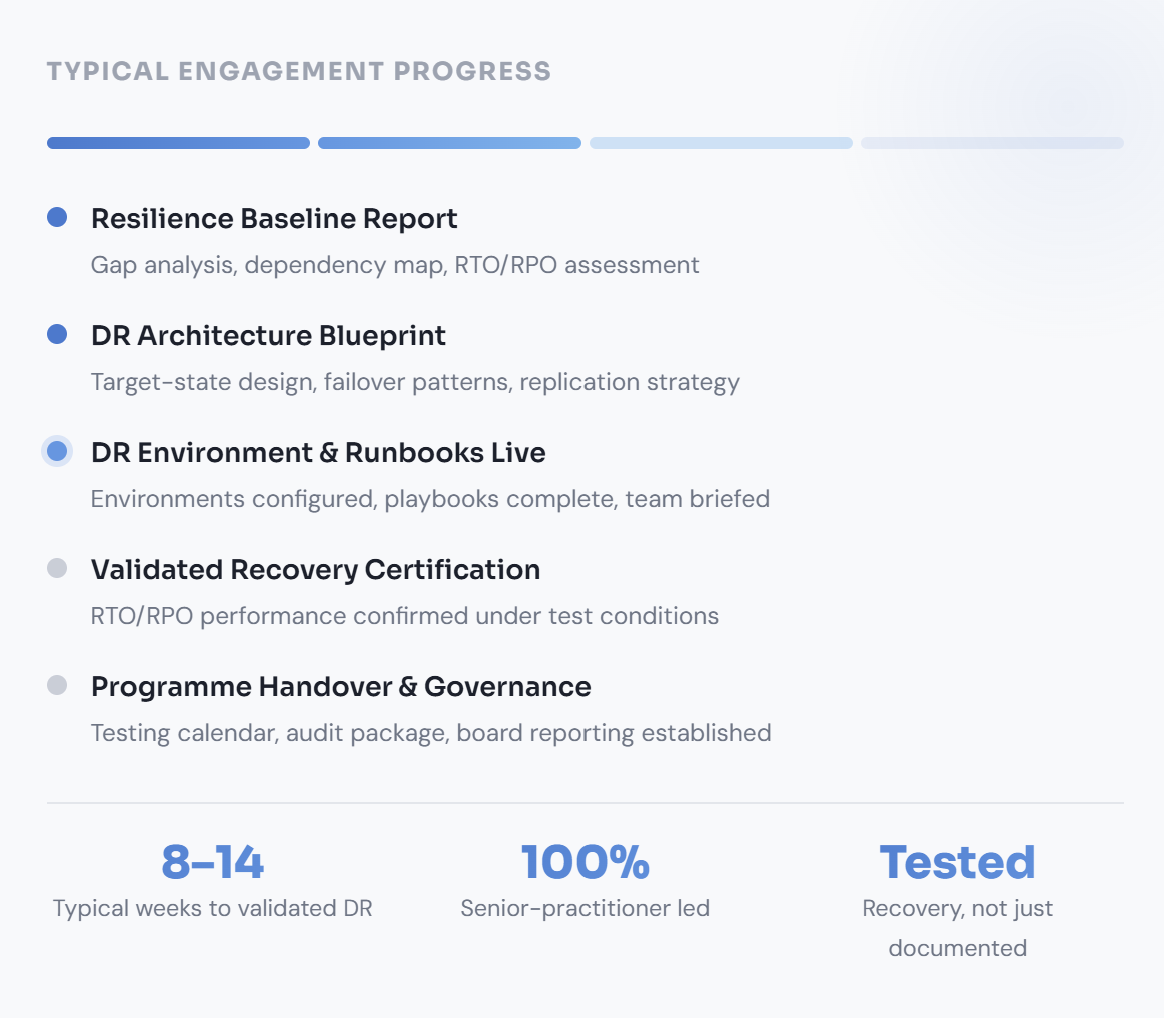
We evaluate your existing DR capability — architecture review, RTO/RPO gap analysis, dependency mapping, and BCP documentation audit — producing a baseline resilience posture report with a prioritised remediation plan.
Based on assessment findings and business requirements, we design the target-state DR architecture, failover patterns, BCP framework, and crisis playbook structure — with RTO/RPO targets documented for each critical workload and business function.
Implementation of the DR architecture — recovery environments, replication pipelines, failover routing, and IaC-based configuration — alongside complete runbook and playbook documentation ready for activation.
Structured testing programme — tabletop exercises for crisis response, controlled failover tests for technical recovery, and measured validation of actual RTO/RPO performance against targets. Each test produces a formal report with findings and remediation actions.
Formal handover of the DR programme — documentation, runbooks, testing schedules, governance frameworks, and a structured knowledge transfer to your team. Where ongoing managed DR operations are required, we transition into a defined managed service engagement.
Most organisations treat disaster recovery as a compliance exercise — plans documented, auditors satisfied, capability unverified. We treat it differently. Resilience is an architectural property that must be designed in. Recovery is an operational discipline that must be practised until it is reliable. The difference between these two perspectives is the difference between an organisation that survives an incident and one that discovers, during the incident, that its plan does not work.
An RTO of four hours is not a commitment — it is a target. A commitment is an architecture that has been designed, built, and validated to recover a workload in four hours under realistic failure conditions. We treat RTO and RPO as engineering constraints that drive every architecture decision — replication frequency, standby configuration, failover routing, and recovery sequencing. The target does not exist until the architecture that delivers it exists. We build the architecture first and then verify that it meets the target — not the other way around.
Resilient systems are designed by engineers who assume that components will fail, networks will partition, regions will become unavailable, and third-party services will degrade without warning. This is not pessimism — it is the correct engineering baseline. We design DR architectures by working backwards from failure scenarios, not forwards from a functioning system. Every dependency is a potential single point of failure until it is either eliminated or protected. We map dependencies, challenge assumptions, and build recovery capability around the failures that are most likely and most consequential — before they happen.
Documentation does not recover workloads. Runbooks that have never been executed under pressure will fail at the worst possible moment — not because the steps are wrong, but because the people executing them have never done it before, the environment has drifted since the runbook was written, and the assumptions baked into the procedure do not reflect reality. We validate recovery plans through structured testing — controlled failover exercises, timed recovery measurements, and scenario-based tabletops — because the only credible evidence of recovery capability is a completed test with a documented outcome.
Technical recovery capability is necessary but not sufficient. The people responsible for executing recovery — engineers, incident commanders, communications leads, and executives — must know what to do, in what sequence, under what authority, and with what information. Operational readiness is built through rehearsal. We design testing programmes, crisis simulation exercises, and escalation frameworks that ensure your teams are not learning how to respond during an actual incident. Recovery discipline is practised, not assumed.
Structured service areas — each with a defined scope, clear deliverables, and a senior DR practitioner
accountable for outcome from assessment through validated recovery certification.
A comprehensive evaluation of your current disaster recovery and business continuity capability — producing a baseline resilience posture report, RTO/RPO gap analysis, dependency map, and a prioritised improvement roadmap with effort and cost estimates.
Design and implementation of the target-state disaster recovery architecture — failover topology, data replication, recovery zone configuration, and infrastructure-as-code deployment across cloud and hybrid environments.
Development of a business continuity programme grounded in operational realities — Business Impact Analysis, BCP documentation, continuity procedures for critical functions, and a governance framework structured for ongoing maintenance and audit readiness.
A structured testing programme that validates recovery capability under realistic conditions — from tabletop crisis exercises that stress-test procedures and decision-making to live controlled failover tests that measure actual recovery performance against documented RTO/RPO targets.
A disaster recovery programme implemented and then left unattended is a programme that will fail when it is needed. DR environments drift, architectures change, and teams turn over. Our managed services practice maintains the recovery capabilities we’ve built — through structured operations, scheduled testing, and continuous assurance.
Continuous security posture and compliance monitoring — maintaining the controls and audit evidence that underpin your DR programme’s regulatory standing and board assurance.
SRE-led managed operations with SLO tracking and incident management — ensuring the primary platform your DR programme protects remains stable, observable, and measurable.
Operational control across cloud compute, storage, and network — managing the infrastructure foundations that both primary workloads and DR environments depend on, with defined SLAs and monthly reporting.
A structured two to three week assessment — baseline resilience report, RTO/RPO gap analysis, dependency map, and prioritised remediation roadmap.
Structured tabletop exercise or controlled failover test — designed, facilitated, measured, and documented with a formal post-test report and remediation actions.
You speak with the senior practitioner who would lead your engagement — no pre-sales intermediary, technically grounded, no obligation.
Every DR and BC engagement is measured against one outcome: demonstrable recovery capability
under realistic conditions. Our delivery structure ensures that what we build is documented, tested,
and operationally owned before we close the engagement.
Concrete technical and programme outputs delivered throughout the DR engagement lifecycle — reviewed, tested, and formally accepted at each phase gate.
Delivery governance with measurable milestones, defined accountability, and explicit quality standards applied across every DR engagement.
Clearly defined scope and accountability from kickoff — no ambiguity about what is in scope, who owns each workstream, and what the acceptance criteria are at each phase gate.
Structured phases with documented outputs, formal gate reviews, and reporting cadence. Each phase is accepted before the next begins — no phase collapse.
No engagement is closed without documented test evidence. Recovery capability is certified against actual test results — not against documented architecture alone.
Formal knowledge transfer is a deliverable, not an afterthought — including runbooks, architecture documentation, and a structured handover session with your operations team.
All deliverables are structured to support regulatory audit requirements — ISO 22301, DORA, PCI-DSS, HIPAA, and sector-specific frameworks where applicable.
A documented DR maturity improvement roadmap delivered at engagement close — with prioritised actions to maintain and advance recovery capability over time.
Connect with our team to discuss your data, cloud, or security landscape and define a clear, structured path forward.
Testimonials
Pricing
Single Project
Single Prost
Portfolio